
Category: Commercial Diagnostic

  • Promotions May Be the Most Time-Consuming Retail Activity for the Lowest Strategic Return. Changing This Paradigm Is Easier Than Most Think

    Promotions May Be the Most Time-Consuming Retail Activity for the Lowest Strategic Return. Changing This Paradigm Is Easier Than Most Think

    The efforts invested in promotions are often difficult to justify when compared to the strategic value they actually deliver. This is not a new debate. And yet, it remains one of the most persistent discussions in retail.

    This article is not arguing against promotions. It argues that promotions have become far more strategic than many organizations still realize.

    Promotions no longer influence only short-term sales. They now shape supplier relationships, shopper expectations, loyalty dynamics, operational complexity, organizational focus and team productivity . And increasingly, promotion performance is no longer only about: “What is the offer?”

    But also: “Who actually sees it?”

    If promotions have become strategic, then they must be planned, managed, and measured strategically as well.

    The Challenging Anatomy of Promotions

    Promotions consume enormous amounts of energy inside retail organizations.

    Buyers negotiate them. Category Managers review them. Suppliers fund them. Marketing teams communicate them. Supply chains prepare for them. Stores execute them. Leadership monitors them weekly.

    And yet, despite this level of attention, promotions often generate disappointing incremental margin and limited long-term value.

    Not because promotions do not work.

    But because many organizations still manage promotions primarily as pricing events instead of strategic decision systems.

    A promotion is not simply: “20% off.”

    It is the combination of multiple interconnected decisions that influence:

    • shopper behavior
    • supplier relationships
    • operational complexity
    • category economics
    • loyalty dynamics
    • team productivity
    • long-term retail positioning

    And increasingly, the most important promotion decision is not only: “What is the offer?”

    But also: “Who actually sees it?”

    The Hidden Cost of Promotion-Centric Retailing

    In many organizations, promotions gradually become the center of commercial activity.

    Teams spend their weeks:

    • negotiating mechanics
    • discussing discount depth
    • resolving supply issues
    • adjusting forecasts
    • managing supplier pressure
    • fixing execution gaps
    • reviewing temporary uplifts

    Over time, this creates an unintended consequence:

    The organization starts optimizing for promotional activity instead of retail value creation.

    The result is often:

    • increasing operational complexity
    • fragmented priorities
    • unstable demand patterns
    • growing execution pressure
    • margin erosion
    • declining differentiation

    But the biggest cost may be elsewhere.

    Promotions consume organizational attention that could otherwise be invested in:

    • assortment strategy
    • shopper understanding
    • category development
    • pricing architecture
    • loyalty quality
    • retail media effectiveness
    • execution capability
    • long-term growth initiatives

    Promotions are supposed to support strategy.

    In many retail organizations, they slowly replace it.

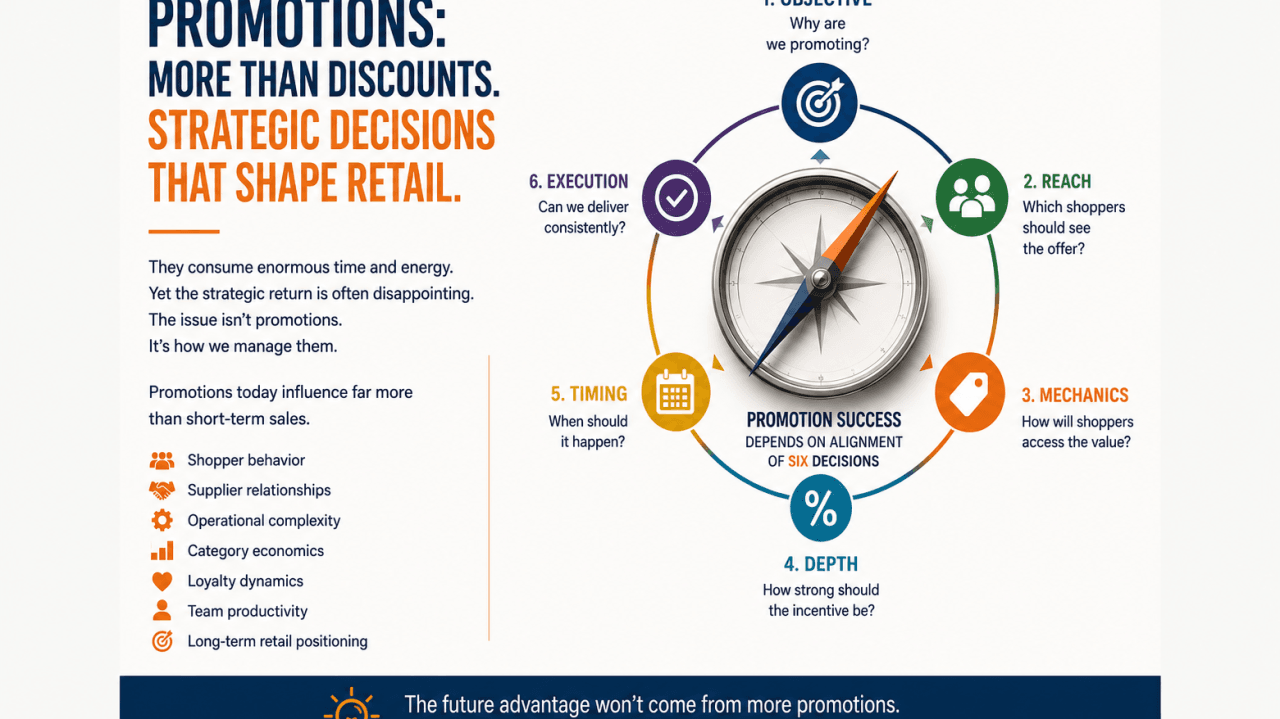
    Promotion = 6 Interconnected Decisions

    Most promotional discussions focus almost entirely on discount depth. But promotion performance is usually determined by the alignment of six decisions:

    1. Why are we promoting? [Objective]
    2. Which shoppers should see the offer? [Reach]
    3. How will shoppers access the value? [Mechanics]
    4. How strong should the incentive be? [Depth]
    5. When should it happen? [Timing]
    6. Can we deliver consistently? [Execution]

    The issue is not that retailers promote too much. The issue is that these decisions are often disconnected.

    And disconnected promotional decisions create disconnected retail outcomes.

    Objective — Defining the Role of the Promotion

    Many promotions begin with: “What can we promote next month?”

    Instead of: “What are we trying to achieve?”

    That difference changes everything.

    A promotion can aim to:

    • drive traffic
    • recruit shoppers
    • increase basket size
    • accelerate penetration
    • defend market share
    • support innovation
    • reinforce loyalty
    • clear inventory

    Without a clear objective, organizations often evaluate promotions only through sales uplift. But sales alone rarely define strategic value.

    A promotion that increases short-term volume while weakening loyalty, margin, or price credibility may actually damage the category long term.


    Reach — The Most Underestimated Modern Promotion Lever

    Traditional retail promotions were mostly mass events. Everyone entering the store saw roughly the same offer. That is no longer true.

    Today, retailers can target:

    • loyalty members
    • specific shopper missions
    • regions
    • channels
    • high-value customers
    • lapsed shoppers
    • app users
    • category buyers

    This changes promotion economics fundamentally, because the key question becomes: “Which shoppers actually require the incentive?”

    Mass promotions often maximize visibility / Targeted promotions often maximize profitability.

    And increasingly, suppliers want visibility not only on:

    • funding
    • sales uplift
    • visibility

    but also on:

    • audience quality
    • incrementality
    • penetration impact
    • retention effect
    • shopper acquisition

    This is progressively transforming Joint Business Plans from: funding negotiations into: joint shopper development discussions.

    Mechanics — Simplicity Is Often Undervalued

    A straight discount, a multi-buy, a bundle, a threshold offer, or a loyalty activation may all deliver very different shopper behaviors. Even with identical investment levels.

    Mechanics influence:

    • perceived value
    • basket construction
    • switching behavior
    • execution complexity
    • shopper understanding

    The more complex the promotion becomes, the more friction it creates for shoppers, stores, and teams. Sophisticated mechanics often look better in presentations than they perform in reality.


    Depth — The Most Discussed but Least Sufficient Decision

    Most promotion discussions still revolve around: “How deep should the discount be?” But discount depth alone explains surprisingly little.

    Too shallow: shoppers ignore the offer

    Too deep, and the following happens:

    • margins collapse
    • pantry loading increases
    • future demand gets cannibalized
    • regular pricing credibility weakens

    Eventually, shoppers stop evaluating value. They start waiting for deals.

    That changes the retailer-shopper relationship fundamentally.

    Timing — Often More Powerful Than Discount Depth

    A strong promotion at the wrong moment still fails.

    Timing includes:

    • seasonality
    • payday cycles
    • weather
    • shopper missions
    • competitive pressure
    • retailer events

    Many promotions are planned around internal calendars instead of shopper behavior. In some categories, improving timing creates more value than increasing promotional investment.


    Execution — Where Promotions Frequently Collapse

    A promotion only exists if shoppers can actually experience it. Which means execution is not operational detail.

    It is part of the strategy itself.

    Questions include:

    • Was stock available?
    • Was pricing correct?
    • Were displays implemented?
    • Were stores aligned?
    • Did replenishment adapt?
    • Were digital assets activated?

    Many organizations analyze promotion performance without separating: strategy failure from execution failure.

    As a result, they repeatedly learn the wrong lessons.

    Promotions Also Reshape Organizations

    This may be the most underestimated consequence of all. Promotion-heavy retailing changes how organizations allocate time.

    The more operationally intensive promotions become:

    • the more teams work reactively
    • the more cross-functional friction increases
    • the more short-term firefighting dominates agendas

    Eventually, commercial teams spend more time managing temporary events than building structural retail capabilities.

    And this has strategic consequences:

    • weaker innovation
    • fragmented accountability
    • slower decision-making
    • decision fatigue
    • reduced organizational agility

    The issue is not promotions themselves.

    The issue is when promotions consume so much organizational capacity that they crowd out higher-value commercial work.

    What Mature Promotion Organizations Do Differently

    The strongest retail organizations do not necessarily promote less. But they manage promotions differently.

    They progressively move:

    • from mass promotions to targeted activation
    • from funding discussions to shopper growth discussions
    • from sales uplift metrics to incrementality measurement
    • from siloed planning to integrated decision-making
    • from reactive calendars to promotional architecture
    • from promotional intensity to promotional precision

    Most importantly, they recognize that promotions are not isolated commercial events.

    They are part of a broader retail decision system connecting:

    • pricing
    • assortment
    • loyalty
    • media
    • supply chain
    • execution
    • supplier collaboration
    • shopper strategy

    And that changes the role of commercial teams entirely. The objective is no longer simply: “Deliver the next promotion.”

    It becomes: “Continuously improve the quality and productivity of promotional decisions.”

    What Are the First Things You Can Do to Change This Promotion Paradigm?

    Changing promotion effectiveness does not necessarily require a complete transformation. In many organizations, meaningful progress starts with a few structural shifts.

    1. Separate Promotion Objectives

    Stop evaluating all promotions through sales uplift alone.

    Traffic activation, penetration growth, loyalty activation, inventory reduction, and category recruitment are different objectives requiring different success metrics.

    2. Introduce Reach as a Strategic Decision

    Do not ask only: “What is the offer?” Also ask: “Which shoppers actually need this incentive?” Mass promotions and targeted promotions should not be managed identically.

    3. Measure Incrementality More Systematically

    A promotion that generates volume is not necessarily creating value. Start distinguishing:

    • transferred sales
    • pantry loading
    • subsidized loyal shoppers
    • genuine incremental growth

    4. Reduce Mechanical Complexity

    Many promotions fail because they create friction. Simpler mechanics often improve:

    • shopper understanding
    • execution consistency
    • operational productivity

    5. Separate Execution Reviews from Strategy Reviews

    A bad promotion and a badly executed promotion are not the same thing. Organizations that separate these discussions learn faster.

    6. Protect Time for Structural Category Work

    If commercial teams spend most of their time managing promotions, the organization becomes operationally reactive. Promotions should support retail strategy — not consume it.


    The Real Strategic Question

    The important question is not: “Should retailers promote less?” Promotions remain essential retail tools.

    The real question is: “How strategically does the organization manage promotions?” Because promotion management shapes far more than short-term sales.

    It shapes:

    • supplier relationships
    • shopper expectations
    • loyalty dynamics
    • operational complexity
    • organizational focus
    • commercial culture
    • long-term competitiveness

    And ultimately, the way promotions are managed reflects the maturity of the retail decision system itself.

    The retailers that will outperform in the coming years are unlikely to be those running the most promotions. They will be those making the best promotional decisions.
  • Retail Signals-May 2026 

    Retail Signals-May 2026 

    The Mechanics of Alignment: Moving Beyond the “Add/Delete” Reflex 

    The Retail Reality: May and the Execution Gap 

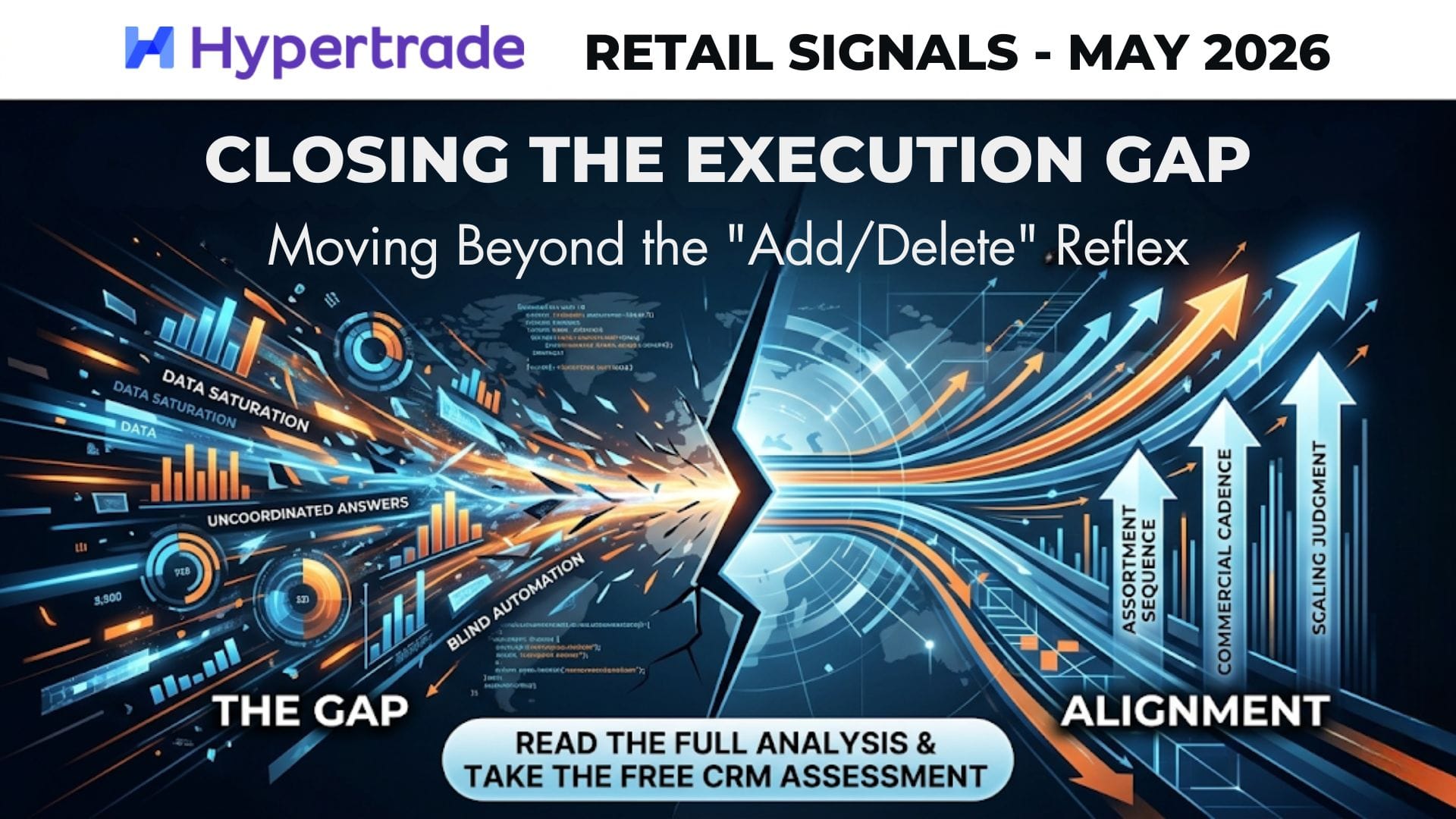
    While the first months of 2026 established the high stakes of the “Discipline Era” and the push toward agentic speed, May has brought a different reality into sharp focus. The primary bottleneck to retail growth is no longer a lack of technology, data, or AI infrastructure. The true operational ceiling is the execution gap—the critical friction point where massive data sets fail to translate into aligned, consistent actions on the retail floor. 

    The industry has largely solved how to generate insight. Global retail leaders are successfully deploying complex AI networks to automate logistics and track real-time shopper behavior. Yet, within typical category teams, decisions remain slow, inconsistent, and fragmented across departments. AI and advanced data stacks are becoming the operational backbone of retail, but without underlying decision alignment, they risk simply becoming a faster way to produce uncoordinated answers. 

    The Three Major Shifts of May 

    • From SKU Negotiation to Sequence Logic: Assortment reviews too often devolve into a tactical tug-of-war over what stays and what goes. Leading organizations are shifting the agenda away from the SKU list itself, treating range as the final consequence of a structured, macro-level sequence. 
    • The Convergence of Commercial Cadences: Historically separate functions—pricing updates, promotional planning, and range optimization—are forcing a structural collapse of organizational silos. Making decisions on separate timelines with isolated data sets is directly driving margin leakage. 
    • The Scaling of Merchant Judgment: Transformation frameworks are moving away from rigid, black-box automation that attempts to replace human expertise. Instead, the focus has pivoted toward embedding shared decision logic to scale human intuition and commercial instinct consistently across diverse teams. 


    CEO Perspective:  

    A note from the team 

    This month we are sharing something we have been thinking about for a while — a paradox we see in almost every retail market we operate in. Most retailers know their CRM data should be doing more. Very few have made the structural changes required to make it happen. The gap between those two positions has a precise commercial cost, and we have tried to quantify it as honestly as we can. 

    The full analysis is on our blog — benchmarks, case studies, a three-horizon ROI timeline, and the five structural moves required to close the gap. But before you read it, we built something practical: a free interactive CRM Maturity Assessment that scores your operation across five dimensions and gives you an instant strategic diagnosis. 

    →  Take the CRM Assessment (free, 3 minutes)

    →  Read the full article 

    THIS MONTH’S FEATURE 

    Your CRM is costing you more than you think. 

    Most retailers are using their most powerful commercial asset as a media channel. Here is the paradox — and what the leaders are doing instead. 

    Retail is under more pressure than it has been in a decade. Consumer confidence is fragile, promotional intensity is at a decade high, and private label is accelerating as shoppers reprice their loyalty. In this environment, CRM should be the most powerful tool in the commercial arsenal. 

    And yet most retail CRM programmes are doing something entirely different from what their leadership teams intend. 

    CRM is being used as a media channel when it should be operating as a business intelligence system with a communication layer on top. 

    The result is a paradox with a measurable commercial cost — one that rarely appears on any dashboard, because the damage accumulates slowly while the short-term metrics look reassuring. 

    0.8–1.4× true ROI, media channel model 2.8–5× net ROI, BI system at maturity 14–36m to break-even on the transition 

    The gap is structural, not technical 

    The platforms exist. The data is there. The gap is organisational: CRM sits in marketing, merchandising sits elsewhere, supplier co-funding distorts incentives, and short-term metrics make the damage invisible until it is already compounding. 

    The hidden cost most retailers miss: systematic discounting through CRM trains the customer base to wait for deals, eroding baseline gross margin by 150–300 basis points over three years. This never appears on a campaign ROI report. 

    What the leaders have achieved 

    A small number of retailers have closed the gap — running short-term campaign performance and long-term intelligence building simultaneously. The results are documented: 

    •  Kroger (USA): $1B+ annually from retail media, +40–60 bps gross margin improvement, ~20% churn improvement — built by separating data science from campaign execution entirely. 

    •  Tesco / dunnhumby (UK): UK grocery market share grew from 19% to 31% in a decade. Basket data restructured entire category strategies. The competitors were copying blind. 

    •  Amazon (Global): $46.9B advertising revenue, 93% Prime retention after year one, 2.5× CLV versus non-Prime members. Every transaction feeds the intelligence system. 

    •  Carrefour (in progress): The most instructive live case — 5 to 7 years behind Kroger, with the ambition clearly stated and the execution gap clearly visible. The closest mirror for most legacy retailers. 

    After three to five years of the BI operating model, the data asset compounds into a moat a competitor cannot close with investment alone. The retailers reacting to customer behaviour today will still be reacting in five years. The ones anticipating it are already pulling away. 

    In the full article you will find: a full ROI benchmark table across seven metrics · documented case outcomes for Kroger, Tesco, Amazon, and Carrefour · a three-horizon ROI timeline with break-even by data maturity · the five-dimension CRM maturity diagnostic · and the five structural moves required to make the transition. 

    Read the full analysis on our blog → 

    The CRM Paradox: benchmarks, case studies, a five-dimension diagnostic, and a transition roadmap. 

    Retail CRM Diagnostic: Evaluate Strategy & Margins | Hypertrade

    Or book a 45-minute live demo on your own data · hyper-trade.com/contact-us


    What We Paid Attention To This Month 

    1. The Data Saturation Paradox 

    • What it says: Retailers have never possessed more real-time shopper analytics, yet executive leadership teams report that cross-functional decision cycles are slowing down. 
    • Why it matters: Drowning in dashboards creates change fatigue. When different departments interpret the same data visualizations through separate departmental lenses, the organization stalls. 
    • What it reinforces: This highlights the necessity of the Category Decision Centre. The goal cannot be to provide more data; it must be to enforce a shared logic that dictates exactly what to do next based on that data. 

    2. The Danger of “Blind Automation” 

    • What it says: The rapid deployment of automated commercial tools has led to unexpected margin leakage when pricing engines operate entirely independently of promotional calendars. 
    • Why it matters: AI is an exceptional operational backbone, but automating a fragmented process simply accelerates the chaos. A pricing decision made without real-time cross-functional visibility completely undermines overall category targets. 
    • What it reinforces: This validates the critical rollout of the Promotion and Range Decision Centres, ensuring that interdependent choices are locked together before any automated execution hits the shelf. 

    3. The Shift in the Assortment Agenda 

    1. What it says: Mid-year performance reviews indicate that retailers maintaining stable, profitable assortments are those who have banned the standard SKU list from forming the baseline of the meeting agenda. 
    • Why it matters: When the SKU list is the starting point, the review automatically devolves into a reactive negotiation. Stability is achieved only when the product choice is treated as a consequence of strategy, not the anchor. 
    • What it reinforces: This proves the value of a structured sequence—anchored by Category Role and Shopper Mission—to make shelf outcomes predictable, profitable, and perfectly aligned with localized shopper behavior. 

    4. The Illusion of Promotional Performance

    • What it says: Retail organizations are increasingly measuring promotional compliance with high rigor, while inadvertently overlooking the true quality and long-term margin impact of those decisions.
    • Why it matters: A packed promotional calendar often masks a deeper deficit in commercial intentionality. When teams optimize isolated KPIs or let the calendar dictate activity rather than shopper need, high-volume promotions can systematically destroy baseline gross margin rather than create long-term value.
    • What it reinforces: This strongly validates the necessity of governing promotions with the same strategic rigor as capital allocation. It underscores the value of the Promotion Decision Centre, proving that future competitive advantage will not come from running more promotions, but from executing fewer, better-connected ones built on a unified commercial logic.

    Success in the remainder of 2026 will not belong to the retail organizations that accumulate the most data, but to those that can connect their insights to execution at scale. By replacing the isolated reflexes of the past with the coordinated flow of a true Retail Decision System, organizations move past the noise of the dashboard and turn decision alignment into a structural competitive advantage. 

    Is your commercial team still relying on reflexes, or are they executing a system?