Hypertrade | Retail Decision Systems
The Split-Screen Retail Economy
The Retail Reality
US retail and food services sales slipped 0.6% in July compared with June — the first monthly decline in over a year and the sharpest in 14 months — even as sales still sit 5.0% above July 2025. (Census Bureau data, reported August 14)
Consumer confidence is moving the opposite direction from the headline growth number: the University of Michigan sentiment index fell to 51 in August, down from 55.2 in July, and PYMNTS reporting puts 67% of consumers living paycheck to paycheck, with only 8% expecting income gains to outpace inflation.
Nonstore (online) retail fell 2.2% month-over-month in July — yet is still up 7.7% year-over-year. Clothing and accessories rose 1.9% MoM while electronics and appliances fell 0.5%. The category-by-category picture is not one story; it’s a dozen small, contradictory ones.
Back-to-school spending is forecast to reach $43.3 billion this year, up roughly 11% from $39 billion in 2025 — but 47% of shoppers now say they’ll buy only the essentials and defer the rest of the list, leaning harder on credit cards and buy-now-pay-later to get there.
The underlying shift: the industry-level numbers and the shopper-level reality are no longer telling the same story, and retailers reading only one of the two are drawing confident conclusions from half the picture.

The Three Major Shifts of August
Agentic commerce moved from pilot to plumbing. All three major US card networks — Mastercard, Visa, American Express — now support agentic transactions, and generative-AI referral traffic to US retail sites is up as much as 4,700% year-over-year, with AI agents completing over 165 million real purchase transactions in the same period (as we posted Aug 11; Aug 13). A new industry report pegs global agentic commerce revenue at $3–5 trillion by 2030, but flags payment authorization, digital identity, and consumer trust as the barriers still standing between pilot and mainstream. The question retailers face has changed from “which AI tool do we deploy” to “is our infrastructure compatible with the agents already transacting on our customers’ behalf.”
The format divide widened inside single sectors, not just across them. In the same week Albertsons cut its sales outlook, Target opened 11 new stores averaging above its 125,000-sq-ft format standard, with six exceeding 140,000 sq ft and expanded fresh-food sections — the exact grocery territory Albertsons is losing (as we posted Aug 4). Target’s Q1 comparable traffic rose 4.4% against Albertsons’ 0.8% decline. Days later, TrendHunter’s August digest named five different physical-retail expansion plays running at once across sportswear, beauty, fandom, and flagship retail (Aug 12). Same sector, same fortnight, opposite trajectories: the differentiator wasn’t category or geography, it was whether the retailer had already decided what kind of retailer it was going to be.

The “barbell shopper” is now the default shopper, not a segment. Albertsons’ own CEO put it in three words on this month’s earnings call — “a very bifurcated situation” — describing lower-income shoppers leaving mid-market grocery for Walmart, Amazon, and Aldi while higher gas prices compress household budgets; Kroger and Sprouts both fell on the read-across (as we posted Aug 5). The same pattern shows up in the aggregate numbers: back-to-school spend is climbing overall while individual households are visibly trading down, deferring discretionary items, and financing the gap with BNPL and revolving credit. Discount retailers are guided to benefit accordingly (Ross projecting 6–7% comparable sales, TJX 2–3%), while full-price and DIY-adjacent categories brace for softness. Retailers optimizing for last year’s shopper — loyal, planned, single-channel — are optimizing for a shopper who increasingly doesn’t exist.
CEO Perspective

The Silent Transfer of Power: Why AI Captures Authority Before It Takes the Job
Public discourse remains divided between macro anxieties over sweeping job displacement and operational struggles with broken data pipelines. Both perspectives miss the true mechanism driving commercial disruption: a job is not wiped out by a single executive mandate; it is hollowed out decision by decision.
In commercial organizations, a white-collar role is fundamentally an aggregated bundle of micro-decisions. When autonomous systems take over pricing, assortment allocation, and recommendation logic, authority does not transfer through a visible coup—it leaks quietly through default configurations and high-speed execution. Imposing superficial manual “sign-offs” only creates cognitive fatigue, inevitably degrading human oversight into a passive rubber stamp governed entirely by the machine’s framing.
True decision governance cannot rely on naive approval bottlenecks. It demands operational rigor:
- Statistical Guardrails over Transactional Approvals: Granting full autonomy to the system within strict variance boundaries (Machine’s Turf) and escalating only genuine anomalies.
- Counter-Factual Surfacing: Requiring models to expose leading alternatives, rejected trade-offs, and data confidence levels for high-stakes strategic choices.
- Single-Threaded Accountability: Designating a named human Directly Responsible Individual (DRI) who retains sole ownership of aggregate business outcomes.
The causal reality is unyielding: data fuels the system, the system absorbs the decision, and the lost decision dissolves the economic rationale for the role. Rather than waiting for external labor policies, leaders must actively audit, define, and defend their operational decision rights today—before algorithmic defaults manage them out of the loop entirely.
[Read the full article →] https://www.linkedin.com/pulse/everyones-debating-whether-ai-takes-job-commerce-its-taking-frederic-r9syc
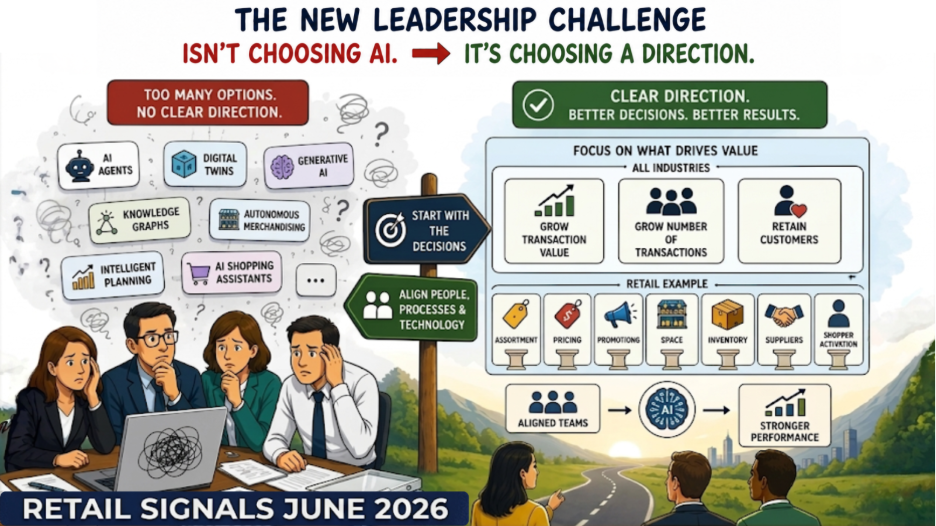
Why This Is a Decision Problem, Not a Data Problem
Every shift above looks, from inside a single function, like good news: traffic is up if you’re Target, agentic referral volume is up if you’re in ecommerce, aggregate spend is up if you’re forecasting back-to-school. It’s only when those signals sit next to the P&L, the shopper research, and the store-format numbers at the same time that the real picture — a market growing in aggregate while getting harder, shopper by shopper, to serve profitably — comes into view.
That’s the problem a Decision System is built to solve: not generating another dashboard, but giving Category, Promotion, Range, and Store-Format decisions a shared, current view of what’s actually happening, so a win in one function doesn’t get read as a signal for the whole business. (Note: as of the June issue, Ariane RDS was still moving toward official release rather than fully live — please confirm current product/module status before this line goes out.)
What We Paid Attention To This Month
01 · Store Concept Innovation “Same sector. Same week. Very different trajectories.” What it says: While Albertsons cut its sales outlook on July 23, Target opened 11 new stores on July 26, every one exceeding its 125,000-sq-ft average format, six topping 140,000 sq ft, all with expanded fresh food sections — directly into the grocery territory Albertsons is losing. Target’s Q1 comparable traffic rose 4.4%; Albertsons’ fell 0.8% over the same period. Target has committed to 300 new locations by 2035, backed by a $5 billion capital plan. Why it matters: The physical store isn’t in decline — undifferentiated physical retail is. The retailers pulling ahead are the ones who decided what kind of retailer to be and built the format to execute it. What it reinforces: Format strategy is a decision-alignment problem before it’s a real-estate problem — capital, category, and range decisions have to move together, not in sequence. → View post (Aug 4)
02 · Retail Margin & P&L / CPG “A very bifurcated situation.” What it says: Those were Albertsons’ CEO’s own words on this week’s earnings call: lower-income shoppers are leaving mid-market grocery for Walmart, Amazon, and Aldi while higher gas prices compress household budgets. Kroger fell 3% and Sprouts fell 1% on the read-across; Albertsons’ own stock lost a quarter of its value in the session. Why it matters: The “barbell shopper” — ruthlessly value-seeking on essentials, selectively premium on what they care about — is no longer a 2024 trend-report prediction. It’s a 2026 earnings-call reality, confirmed by a CEO whose stock just repriced on it. What it reinforces: When your retailer’s CEO says “bifurcated” on an earnings call, the ranging review and promotional plan submitted last quarter needs revisiting this week — not next quarter. → View post (Aug 5)
03 · Ecommerce & Agentic Commerce “The retailers who framed this as a future investment have less time than they thought” What it says: In July, AI retail-tool coverage was about individual tools launching. One month later, the story is agentic commerce networks and AI agent operating systems — infrastructure, not features. All three major US card networks now support agentic transactions; ChatGPT processes 50 million shopping queries daily; the Agentic Commerce Protocol has already handled hundreds of millions of real purchases. Why it matters: The conversation has moved from “which AI tool should we deploy” to “is our infrastructure compatible with the network of agents now transacting on our customers’ behalf” — and the infrastructure is already live. What it reinforces: Readiness isn’t a tool decision anymore; it’s an infrastructure and decision-alignment question. → View post (Aug 11)
04 · Store Concept Innovation “Scale plays and experience plays. In the same month.” What it says: August’s TrendHunter retail digest named five distinct physical retail expansion and experience categories in a single month — Sportswear, Beauty-Focused, K-Beauty, Fandom, and Content-Driven Flagship Retail — spanning different sectors at once. Why it matters: The physical-store decision in 2026 isn’t “stores or digital.” The retailers winning right now are doing both, differently: scaling where the format works, transforming where the experience wins, and measuring both with the same financial rigour as any other P&L investment. What it reinforces: Treating the store as either a cost centre or a marketing budget — but not both simultaneously — is what shows up as an unexplained gap at next year’s earnings call. → View post (Aug 12)
05 · Consumption & Shopper Behaviour “The discovery-to-consideration phase of your customer’s journey has moved somewhere you cannot see” What it says: Adobe Analytics measured a 4,700% year-over-year increase in AI-generated traffic to US retail sites between July 2024 and July 2025, with AI agents completing over 165 million real purchase transactions in the same period. When an agent selects a product on a shopper’s behalf, the retailer sees only the add-to-cart event — everything before it happened inside the chat interface, invisible to the retailer. Why it matters: Retailers can no longer see or influence the discovery and comparison phase directly; what remains controllable is range coherence, pricing accuracy, inventory depth, promotional mechanics, and fulfilment reliability. What it reinforces: When the front end of the funnel goes dark, execution discipline on the parts you still control becomes the whole game. → View post (Aug 13)
August’s numbers say growth. August’s shoppers say caution. Both are true at once, and the retailers who win the next two quarters won’t be the ones with the most data on each — they’ll be the ones who’ve built a way to act on both together, in the same room, at the same time. Everyone else is still reading the industry report and the P&L as two different businesses. Which one are you?