Microsoft recently announced new agentic AI capabilities for retail — AI systems able not only to analyze, but to reason, act, and execute workflows across the business.
It’s an important milestone.
And a powerful one.
But beyond the technology itself, this announcement raises a question that, in my experience, many retailers are not yet asking:
What exactly are we automating?
Speed has never been retail’s real problem
Retailers don’t suffer from a lack of data.
They don’t even suffer from a lack of tools.
They suffer from fragmented decisions.
Range, pricing, promotions, supply, trade marketing —
each team operates with good intentions, solid KPIs, and local logic.
Yet too often:
- decisions are made in parallel
- trade-offs are implicit, not agreed
- teams optimize locally, not collectively
Agentic AI does not magically fix this.
In fact, it accelerates it.
When AI starts deciding faster than organizations can align
Agentic AI systems are designed to optimize, trigger, and execute actions at speed:
- adjusting prices
- activating promotions
- reallocating inventory
- prioritizing execution tasks
But each of these actions is based on a decision logic:
- which KPI matters most?
- which objective has priority?
- what trade-off is acceptable?
- when should humans intervene?
If that logic is not clearly defined and shared, AI doesn’t create clarity.
It creates very fast confusion.
Speed without alignment does not create performance.
It creates noise — faster.
The real challenge is not AI. It is decision design.
The agentic AI conversation often focuses on what technology can do.
The more fundamental question is:
How are decisions supposed to be made?
For example:
- Which KPIs (and their threshold or trigger levels) are legitimate for a pricing decision vs a range decision?
- When sales and margin conflict, who arbitrates?
- What can be automated safely — and what must remain human?
- How do teams understand why a decision was taken?
These are not technical questions.
They are organizational and strategic ones.
And they exist with or without AI.
Agentic AI simply makes them impossible to ignore.
Automation does not remove judgment. It multiplies it.
There is a quiet risk in the current AI narrative:
the idea that better automation means less human judgment.
In retail, the opposite is true.
The more we automate execution, the more important it becomes to:
- clearly define decision boundaries
- make trade-offs explicit
- ensure teams trust the logic behind actions
- preserve the ability to override when context matters
AI can scale execution.
Only humans can scale judgment — if it is structured and shared.
This is ultimately about shoppers, not systems
Shoppers don’t care whether a decision was made by a person or an algorithm.
They care about:
- relevance
- availability
- consistency
- fairness
When decisions are misaligned internally, shoppers feel it externally:
- incoherent assortments
- erratic promotions
- broken promises between channels
Technology can accelerate outcomes — good or bad.
The quality of those outcomes still depends on the quality of decisions upstream.
A quiet shift retailers will have to make
Agentic AI is a forcing function.
It pushes retailers to move from:
- individual decisions → shared decision logic
- isolated KPIs → decision-specific metrics
- tool-driven actions → decision-driven execution
Not because it is fashionable.
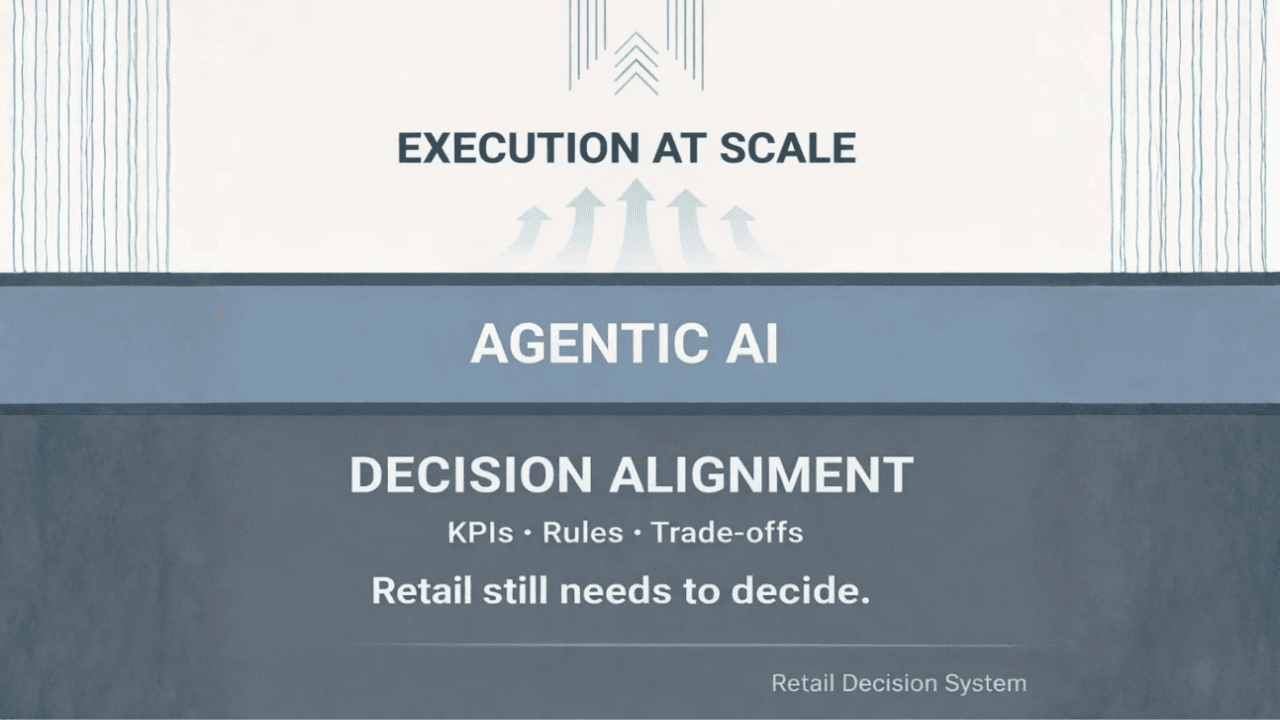
But because execution at scale demands alignment first.
Before asking AI to act, a simpler question matters
Agentic AI will transform retail execution.
That is not in doubt.
But before we ask AI to act on our behalf, retailers may need to pause and ask something more fundamental:
Do we actually agree on how decisions should be made?
Because AI will execute whatever logic we give it.
The real question is whether that logic deserves to be scaled.
Curious to hear how others are thinking about decision governance in an agentic AI world.
About Hypertrade
Hypertrade helps retailers and brands transform fragmented data into a unified engine for growth. Our solutions are designed to bridge the gap between technology and strategic judgment, ensuring that AI-driven execution is always grounded in sound decision logic.
Through Ariane, our advanced decision engine, we empower teams to automate complex analysis while maintaining control over business rules. With our Collaboration Platform and Optimization Tools, we provide the framework needed to align stakeholders, streamline workflows, and scale retail performance with precision.