Your Next Growth Is Already Inside Your Business
Expansion remains a powerful growth lever—but the next frontier is internal, driven by better decisions, not heavier transformation programs.
Since Covid, retail has not had a moment to breathe nor to stabilize.
Shoppers have changed. Margins are under pressure. Channels have multiplied. Priorities keep shifting.
Most leadership teams are operating somewhere between urgency and uncertainty—trying to stabilize today while preparing for tomorrow.
And in that context, transformation often gets delayed.
Not because it is not needed.
But because everything else feels more urgent.
The reality is simple:
there is never a good time for change.
A Market Full of Movement — But Not Always Progress
Across the industry, we see retailers actively trying to adapt. But the responses often follow similar patterns—and many remain incomplete.
Some are resetting their commercial model around efficiency and relevance.
Assortments are being rationalized. Complexity is being reduced. The ambition is clear: move from “more choice” to “better choice.”
Yet too many of these initiatives stall, or create internal friction.
Not because the direction is wrong—but because they are often executed as cost-reduction exercises rather than as a fundamental upgrade of how decisions are made.
Others are accelerating retail media strategies.
Physical stores and digital platforms are increasingly used as marketing assets, unlocking new revenue streams.
This is a powerful lever. But it also reflects a deeper reality:
when shopper-driven growth becomes harder, monetizing attention becomes an alternative.
And of course, AI is now everywhere.
In the last two years, it has moved from experimentation to boardroom priority. Some leaders—like Walmart, Target or Costco—have already taken significant steps forward.
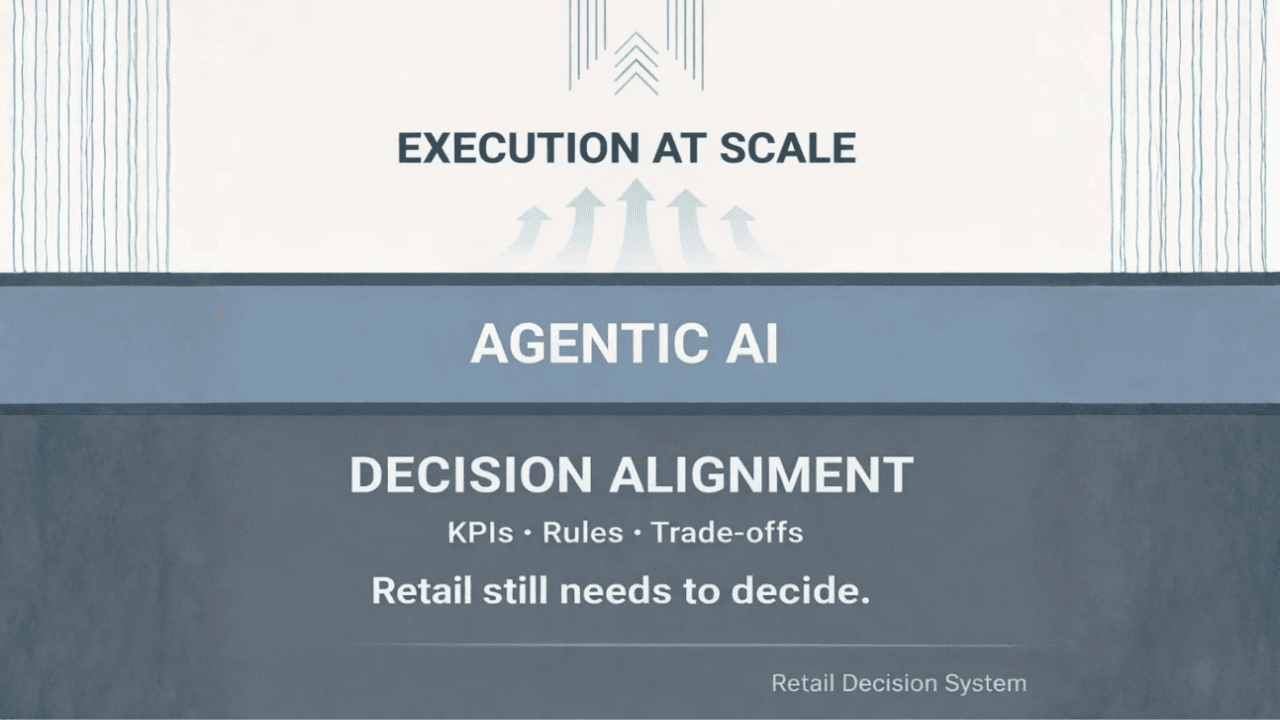
But in many organizations, technology is advancing faster than the ability to consistently translate it into better decisions.
Some leading retailers have already gone beyond pilots—and are using AI where it matters most: to improve decisions that directly impact shoppers.
- Walmart is leveraging AI to optimize assortments, pricing, and replenishment decisions in real time—improving availability while reducing complexity.
- Target is using AI to refine personalization and promotion effectiveness, connecting data directly to customer-facing decisions.
- Costco, known for its disciplined model, is selectively embedding data and AI into its operations to reinforce consistency and execution at scale.
- Kingfisher has accelerated its use of AI across categories and supply chain decisions, and is now partnering with Google to provide Generative AI support to its shoppers.
These are not technology experiments.
They are decision systems designed to impact shoppers (end customers)
And this is the real shift.
The Real Shift: Growth Is Now Internal
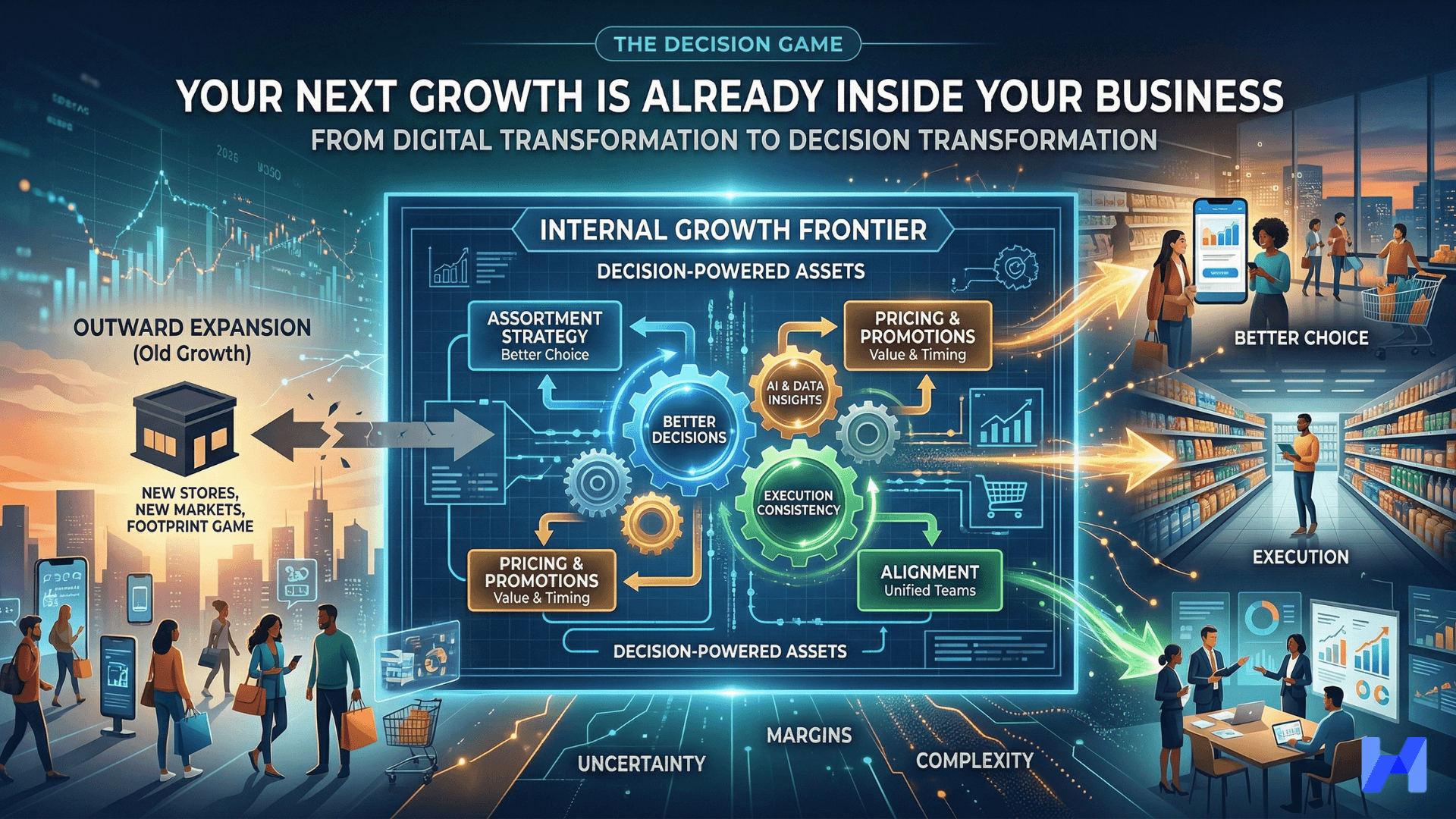
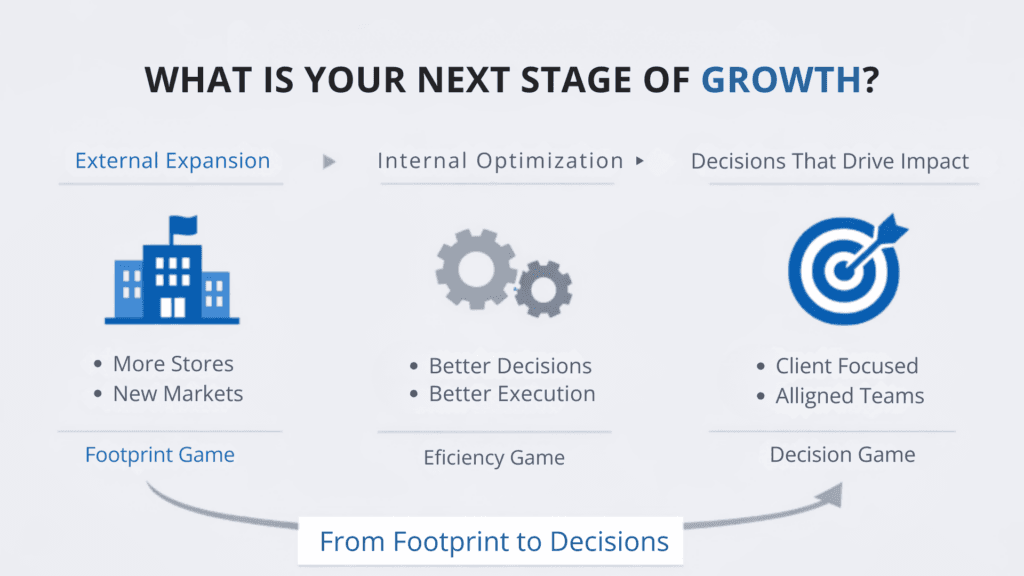
For years, growth in retail was largely driven by expansion—new stores, new markets, new formats.
That era is fading.
In most mature environments, the next wave of growth will not come from outside.
It will come from using existing assets better:
- better assortment choices
- better promotions
- better execution
- better alignment across teams
In other words:
The assets are already there. The question is how well they are used. Growth is no longer a footprint game. It is a decision game.
Transformation Is Not a Technology Topic
For years, “digital transformation” has been associated with:
- new tools
- new platforms
- automation
- cost efficiency
But we are now reaching a turning point.
Because the real question is no longer:
Do we have the right technology?
It is:
Are we making better decisions because of it?
Technology, data, AI—none of these create value on their own.
They only create value when they improve:
- what decisions are made
- how they are made
- how consistently they are executed
This is where many transformation efforts fall short.
Not due to lack of investment.
But due to lack of decision clarity.
Too many priorities. Misaligned teams. Inconsistent execution at store level.
From Digital Transformation to Decision Transformation
What we are witnessing is a shift toward the true meaning of transformation.
It is no longer primarily about digitizing processes or reducing costs.
It is about building the ability to take better decisions, at scale, across the organization.
This means:
- clear prioritization — focusing on what really drives impact
- alignment — ensuring teams operate with the same logic
- consistency — translating strategy into execution, store by store
Because in the end:
The issue is not the lack of data.
The issue is not the lack of tools.
The issue is the gap between insight and action.
There Will Never Be a Perfect Moment
Waiting for stability before transforming is no longer an option.
The retailers who move forward are not those who have more time.
They are those who accept that uncertainty is the new normal—and build systems that allow them to decide and act within it.
They are those who build the ability to decide and act—despite it.
A Simple Question to Start
If transformation is ultimately about decision quality, then the real question becomes:
How ready is your organization to take better decisions at scale?
We have developed a simple self-assessment to help leadership teams evaluate their decision readiness.
👉 Is Your Digital Transformation Actually Driving Better Decisions?