The signals that matter, decoded through the retail causal chain
The Retail Reality
June 2026 delivered a clear message: retail is being reorganised from the outside in. US retail sales reached $763.7B in May, up 6.9% year on year, and the headline looks healthy. But underneath the aggregate, the distribution of that growth is shifting in ways that make the old playbooks unreliable.
Nonstore retailers, platforms, agents, subscriptions, are growing at +12.2% YoY, nearly double the overall rate. The consumer is still spending. But who captures that spend, and how, is being renegotiated in real time. Three shifts are defining this moment.
The Three Major Shifts of June
01 The agent layer is live infrastructure
Agentic commerce moved from pilot to protocol. Google’s Universal Commerce Protocol, Microsoft Copilot Checkout, and Shopify’s Agentic Storefronts are operational. AI-referred retail traffic grew +393% YoY in Q1 2026 — and converted at 42% higher rates than any other source. Getting found is no longer the hard part. What happens after the click is where the game is played.
→ Range · Traffic · Distribution
02 Margin is the new volume
CPG’s “growth at all costs” era is officially over. Investors are demanding margin, velocity, and repeat purchase rate before committing capital. Brands walking into JBP meetings with a volume-only story are presenting with a playbook their own investors have already rejected. Shelf space in 2026 goes to brands that grow the total category profit pool, not just their own share.
→ Price · Margin · Supplier
03 AI investment becomes a boardroom metric
Lowe’s Q1 2026 earnings call was a threshold moment: CEO Marvin Ellison defended AI spend with measurable online conversion gains and in-store metrics. Best Buy, Gap, and Dick’s Sporting Goods followed. AI has moved from experimental budget line to investor-facing KPI. The question is no longer “are competitors exploring this?”, it’s “can we defend our ROI with the same specificity?”
→ Sales · Margin · Spending
Read together through the Ariane RDS causal chain:
The Supplier → Inventory → Distribution nodes are being stress-tested by agent-driven discovery requirements.
The Range and Price nodes face the double pressure of margin scrutiny and AI-mediated selection.
Traffic is increasingly agent-referred, and those agents rank on structured data, not brand story.
CEO Perspective
The New Leadership Challenge Isn’t Choosing AI.
It’s Choosing a Direction.
A few years ago, digital transformation was about adopting new technologies. Today, it is about surviving an explosion of them.
Every week brings another breakthrough: Agentic AI, autonomous merchandising, digital twins, knowledge graphs, and generative AI copilots. The pace of innovation is extraordinary. So is the noise.
For business leaders, the question is no longer “Should we embrace AI?” That question has been answered. The real question is: “Where do we focus, and how do we ensure every investment moves the business in the same direction?”
This isn’t a tech problem. It is a prioritization crisis.
The Fragmented Optimization Trap
Never before have organizations had access to so many powerful capabilities. Never before has choosing the right priorities been so difficult. Every vendor promises transformation, every conference introduces the next breakthrough, and every business case claims compelling returns.
Yet most organizations operate with limited budgets, limited talent, and limited management attention.
When faced with endless choices, many leaders fall into a dangerous trap: they buy isolated AI tools to solve local problems. They deploy a standalone promotion optimizer here, an isolated inventory bot there, and a customer service copilot somewhere else.
This creates fragmented optimization. It makes individual tasks faster, but it creates a disconnected, chaotic mess across the company. The technology becomes smarter, but the overall organization becomes complex, siloed, and brittle.
Retail Simply Makes the Crisis Visible
Retail happens to be the first industry where this fragmentation crisis is impossible to ignore. A modern retail enterprise is not a single business; it is a hyper-complex web of thousands of daily, interlocking commercial decisions.
Every single day, teams must decide:
- Which products belong on which shelves?
- Which promotions will actually drive margin rather than dilute it?
- How should prices evolve dynamically across channels?
- Where must inventory be positioned to prevent stockouts without bloating capital?
Increasingly, a vendor can sell you an isolated AI tool to assist with every single one of these points. But adding localized intelligence without a centralized architecture does not create better outcomes.
If your pricing AI optimizes for short-term margin while your promotion AI optimizes for volume, and your inventory AI cuts safety stock to save cash, the systems actively fight each other. Retail proves that without a unified decision logic, more AI just means faster chaos.
Start With Decisions, Not Technology
The digital age has shifted from a technology gap to a management gap. Competitive advantage no longer comes from having the tool—most companies have access to the exact same cloud platforms and foundational AI models. Advantage comes from the clarity of the decision logic directing those tools.
To avoid the fragmentation trap, transformation cannot start with the tech stack. It must start with a radically simple question:
Which business decisions create the greatest value if we improve them?
In retail, for example, those core value-drivers are clear:
- Assortment
- Pricing
- Promotions
- Space and Inventory Allocation
- Supplier Collaboration
Stop looking at what the technology can do. Look at your most valuable business decisions first. Once you identify which decisions move the needle, technology selection becomes easy. AI stops searching for problems to solve; it becomes an accelerator for decisions that already matter.
The Dynamic Prioritization Framework
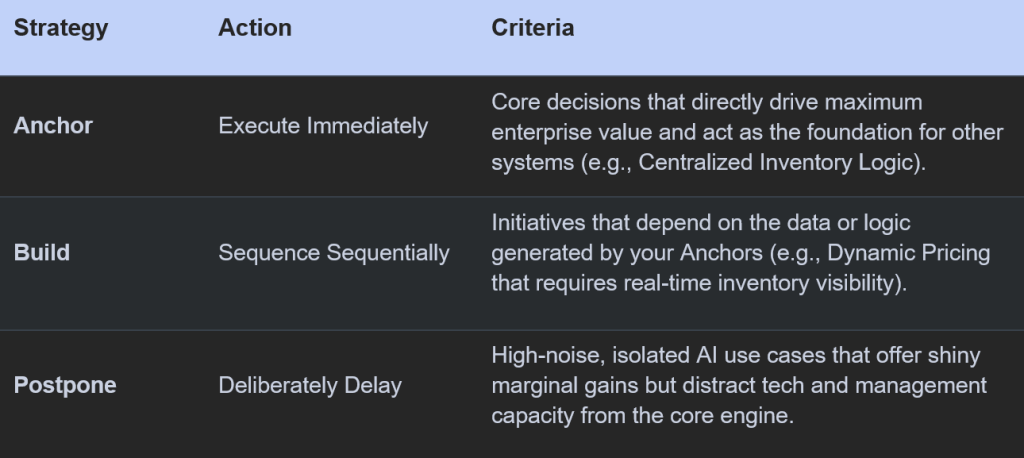
Choosing a direction is not a one-time boardroom exercise. Because AI capabilities evolve continuously, leaders cannot rely on static five-year roadmaps. You need a rigorous framework to sequence your initiatives based on two variables: Value Impact and Decision Interdependence.
To execute this, leaders must ruthlessly categorize every AI opportunity into three buckets:
The Organizations That Will Lead
We are entering a period where leadership itself must evolve. The organizations that succeed will not be those deploying the greatest quantity of AI solutions.
The winners will be the organizations with the absolute clearest direction. They are the ones who know which decisions matter most, align their teams around a unified decision logic, and use technology to strengthen that architecture rather than fragment it.
In a world overflowing with possibilities, the ultimate competitive advantage is not having more AI. It is knowing exactly where to apply it—and ensuring the entire enterprise moves down the same path.
What We Paid Attention To This Month
01 Ecommerce & Omnichannel
Fulfilment just became a pre-purchase ranking signal
When an AI agent compares two merchants at identical prices, it doesn’t read your brand story. It reads your delivery data programmatically, in milliseconds. Real-time stock depth, live carrier connectivity, structured lead times. “Ships in 3–5 business days” is not machine-readable. It will not be selected. Retailers who invested in structured delivery data before this shift will be very difficult to catch.
02 Retail Margin & P&L Pressure
The JBP conversation has changed, has your prep?
A LinkedIn post from a CPG investor asking a founder “when will you be profitable?” caused an uproar that faded quickly because everyone knew the investor was right. Brands walking into JBP meetings in 2026 with a volume-and-distribution story but no margin or repeat purchase narrative are presenting with a playbook their own investors have already rejected. Category profit pool growth is the new entry ticket.
03 Ecommerce & Omnichannel
AI-referred traffic is converting 42% better but the click is just the beginning
In Q1 2026, AI-referred traffic to US retail sites grew 393% year-over-year, and converted at 42% higher rates than any other source. The catch: showing up in ChatGPT or Gemini without a compelling experience behind it means winning the click and losing the customer. Retailers now need to build for two audiences simultaneously, the agents that surface products, and the humans who decide whether to buy.
04 Retail Margin & P&L Pressure
AI investment is now a metric CEOs defend in front of investors
On Lowe’s Q1 2026 earnings call, CEO Marvin Ellison defended AI spending as a driver of measurable online conversion gains and improved in-store metrics. Best Buy, Gap, and Dick’s Sporting Goods made similar claims. For retail leaders still treating AI as an experimental budget line: the question in your boardroom is no longer “are our competitors exploring this?” it’s “can we defend our investment with the same specificity Lowe’s just did?”
05 Southeast Asia Retail Trends
Product discovery in SEA is shifting from keywords to conversations
ChatGPT queries in Southeast Asia jumped nearly 70% in six months. Some retailers are already reporting that up to a quarter of their inbound traffic now arrives from AI assistants — not search engines, not marketplaces, not social feeds. Retailers whose product data isn’t structured for AI readability are already losing visibility they don’t yet know they’ve lost. The US data confirmed the stakes in Q1 2026: AI-referred traffic converts 42% higher than other sources. The same shift is happening in Asia — faster.
06 AI in Retail Decision-Making
When 2,500 retail executives agree on the two hardest problems, that’s a signal
CommerceNext Growth Show 2026 brought together senior leaders from Ulta Beauty, IKEA, Wayfair, Foot Locker, Pandora and more — and its organisers chose two themes: Agentic AI and Loyalty & Retention. Not a coincidence. It’s the industry’s collective diagnosis. Agentic AI because the question has moved from “should we explore this?” to “how do we deploy this responsibly at scale?” Loyalty because with acquisition costs still climbing, growth must now come from depth, not reach. The retailers who will lead aren’t just the ones attending — they’re the ones already building the decision infrastructure to act on both.
Also this month: Hypertrade welcomed Golf (Full Stack Developer) and Tian (DevOps Engineer) to the team as Ariane RDS moves closer to its official release, the engineering and infrastructure layers are growing with it.