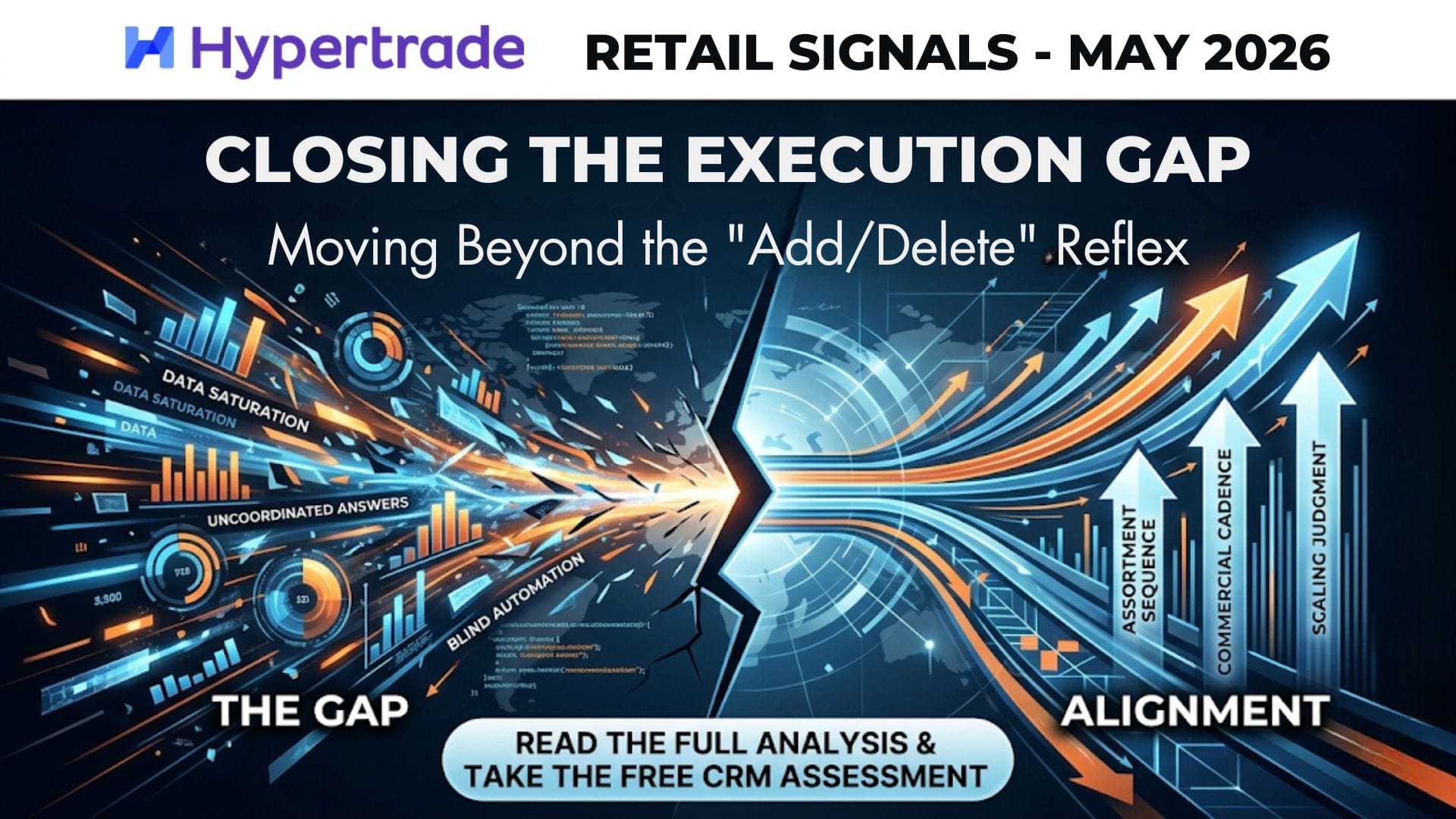
The Mechanics of Alignment: Moving Beyond the “Add/Delete” Reflex
The Retail Reality: May and the Execution Gap
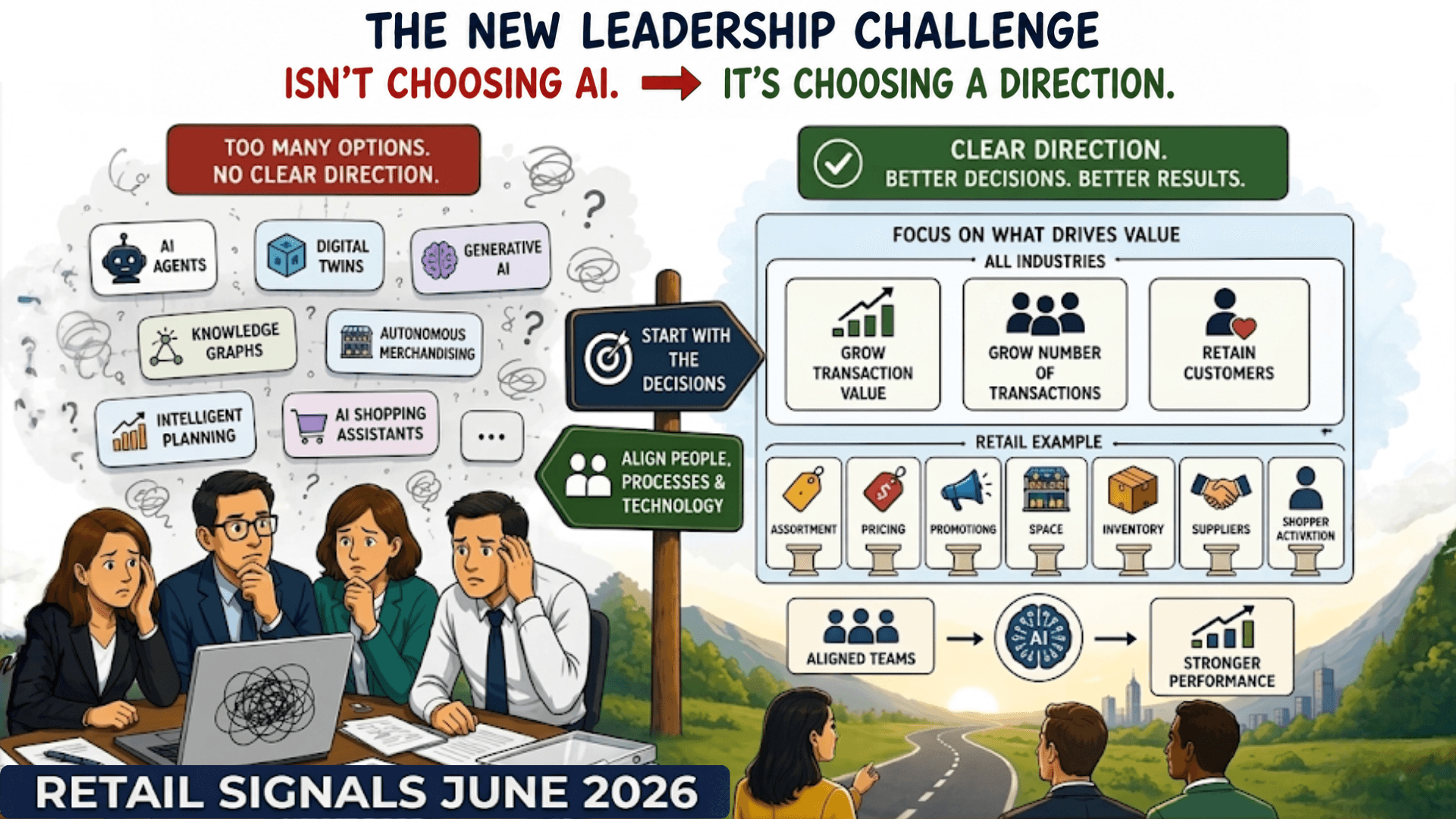
While the first months of 2026 established the high stakes of the “Discipline Era” and the push toward agentic speed, May has brought a different reality into sharp focus. The primary bottleneck to retail growth is no longer a lack of technology, data, or AI infrastructure. The true operational ceiling is the execution gap—the critical friction point where massive data sets fail to translate into aligned, consistent actions on the retail floor.
The industry has largely solved how to generate insight. Global retail leaders are successfully deploying complex AI networks to automate logistics and track real-time shopper behavior. Yet, within typical category teams, decisions remain slow, inconsistent, and fragmented across departments. AI and advanced data stacks are becoming the operational backbone of retail, but without underlying decision alignment, they risk simply becoming a faster way to produce uncoordinated answers.
The Three Major Shifts of May
- From SKU Negotiation to Sequence Logic: Assortment reviews too often devolve into a tactical tug-of-war over what stays and what goes. Leading organizations are shifting the agenda away from the SKU list itself, treating range as the final consequence of a structured, macro-level sequence.
- The Convergence of Commercial Cadences: Historically separate functions—pricing updates, promotional planning, and range optimization—are forcing a structural collapse of organizational silos. Making decisions on separate timelines with isolated data sets is directly driving margin leakage.
- The Scaling of Merchant Judgment: Transformation frameworks are moving away from rigid, black-box automation that attempts to replace human expertise. Instead, the focus has pivoted toward embedding shared decision logic to scale human intuition and commercial instinct consistently across diverse teams.
CEO Perspective:
A note from the team
This month we are sharing something we have been thinking about for a while — a paradox we see in almost every retail market we operate in. Most retailers know their CRM data should be doing more. Very few have made the structural changes required to make it happen. The gap between those two positions has a precise commercial cost, and we have tried to quantify it as honestly as we can.
The full analysis is on our blog — benchmarks, case studies, a three-horizon ROI timeline, and the five structural moves required to close the gap. But before you read it, we built something practical: a free interactive CRM Maturity Assessment that scores your operation across five dimensions and gives you an instant strategic diagnosis.
→ Take the CRM Assessment (free, 3 minutes)
THIS MONTH’S FEATURE
Your CRM is costing you more than you think.
Most retailers are using their most powerful commercial asset as a media channel. Here is the paradox — and what the leaders are doing instead.
Retail is under more pressure than it has been in a decade. Consumer confidence is fragile, promotional intensity is at a decade high, and private label is accelerating as shoppers reprice their loyalty. In this environment, CRM should be the most powerful tool in the commercial arsenal.
And yet most retail CRM programmes are doing something entirely different from what their leadership teams intend.
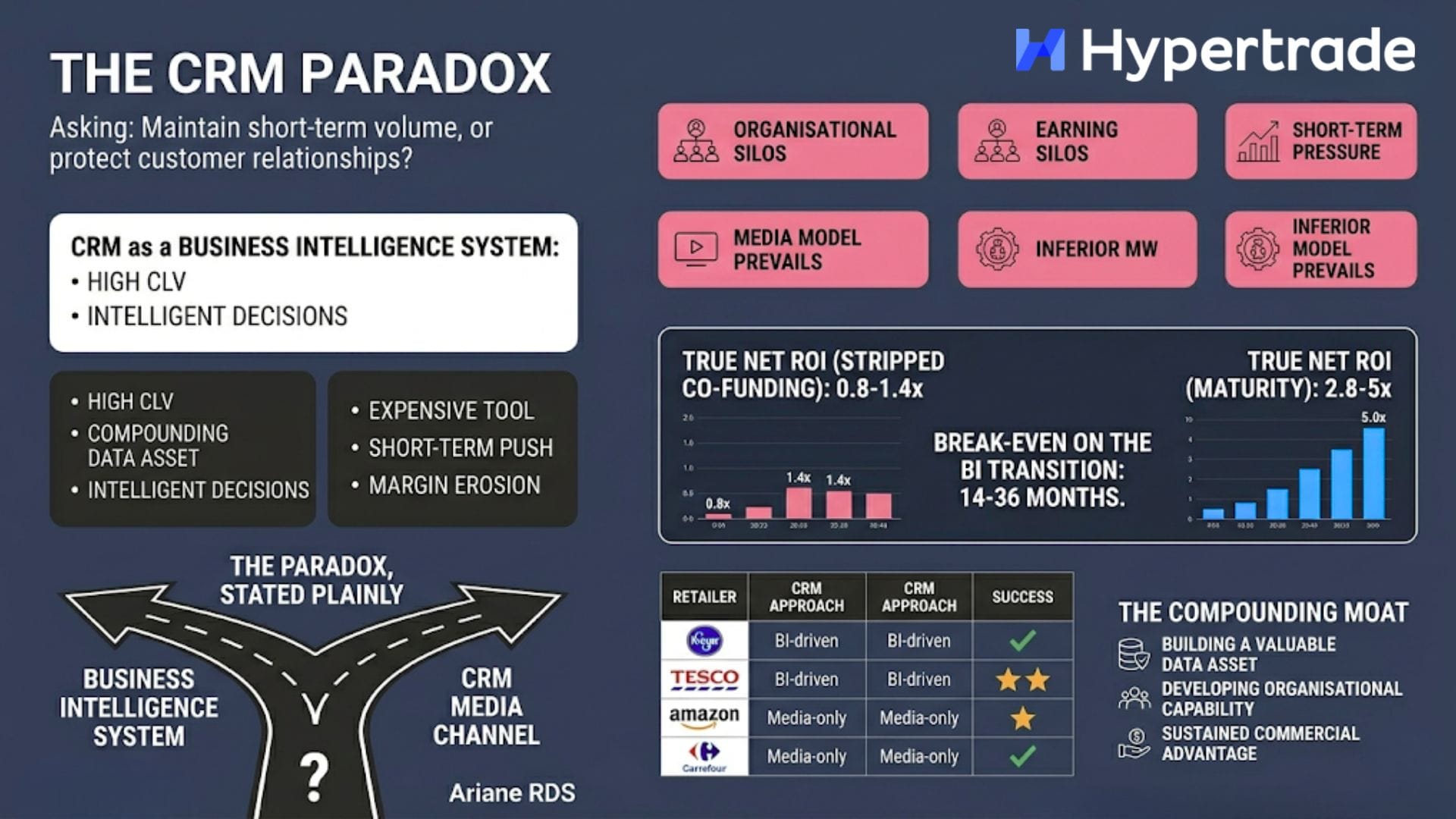
CRM is being used as a media channel when it should be operating as a business intelligence system with a communication layer on top.
The result is a paradox with a measurable commercial cost — one that rarely appears on any dashboard, because the damage accumulates slowly while the short-term metrics look reassuring.
| 0.8–1.4× true ROI, media channel model | 2.8–5× net ROI, BI system at maturity | 14–36m to break-even on the transition |
The gap is structural, not technical
The platforms exist. The data is there. The gap is organisational: CRM sits in marketing, merchandising sits elsewhere, supplier co-funding distorts incentives, and short-term metrics make the damage invisible until it is already compounding.
The hidden cost most retailers miss: systematic discounting through CRM trains the customer base to wait for deals, eroding baseline gross margin by 150–300 basis points over three years. This never appears on a campaign ROI report.
What the leaders have achieved
A small number of retailers have closed the gap — running short-term campaign performance and long-term intelligence building simultaneously. The results are documented:
• Kroger (USA): $1B+ annually from retail media, +40–60 bps gross margin improvement, ~20% churn improvement — built by separating data science from campaign execution entirely.
• Tesco / dunnhumby (UK): UK grocery market share grew from 19% to 31% in a decade. Basket data restructured entire category strategies. The competitors were copying blind.
• Amazon (Global): $46.9B advertising revenue, 93% Prime retention after year one, 2.5× CLV versus non-Prime members. Every transaction feeds the intelligence system.
• Carrefour (in progress): The most instructive live case — 5 to 7 years behind Kroger, with the ambition clearly stated and the execution gap clearly visible. The closest mirror for most legacy retailers.
After three to five years of the BI operating model, the data asset compounds into a moat a competitor cannot close with investment alone. The retailers reacting to customer behaviour today will still be reacting in five years. The ones anticipating it are already pulling away.
In the full article you will find: a full ROI benchmark table across seven metrics · documented case outcomes for Kroger, Tesco, Amazon, and Carrefour · a three-horizon ROI timeline with break-even by data maturity · the five-dimension CRM maturity diagnostic · and the five structural moves required to make the transition.
Read the full analysis on our blog →
The CRM Paradox: benchmarks, case studies, a five-dimension diagnostic, and a transition roadmap.
Retail CRM Diagnostic: Evaluate Strategy & Margins | Hypertrade
Or book a 45-minute live demo on your own data · hyper-trade.com/contact-us
What We Paid Attention To This Month
1. The Data Saturation Paradox
- What it says: Retailers have never possessed more real-time shopper analytics, yet executive leadership teams report that cross-functional decision cycles are slowing down.
- Why it matters: Drowning in dashboards creates change fatigue. When different departments interpret the same data visualizations through separate departmental lenses, the organization stalls.
- What it reinforces: This highlights the necessity of the Category Decision Centre. The goal cannot be to provide more data; it must be to enforce a shared logic that dictates exactly what to do next based on that data.
2. The Danger of “Blind Automation”
- What it says: The rapid deployment of automated commercial tools has led to unexpected margin leakage when pricing engines operate entirely independently of promotional calendars.
- Why it matters: AI is an exceptional operational backbone, but automating a fragmented process simply accelerates the chaos. A pricing decision made without real-time cross-functional visibility completely undermines overall category targets.
- What it reinforces: This validates the critical rollout of the Promotion and Range Decision Centres, ensuring that interdependent choices are locked together before any automated execution hits the shelf.
3. The Shift in the Assortment Agenda
- What it says: Mid-year performance reviews indicate that retailers maintaining stable, profitable assortments are those who have banned the standard SKU list from forming the baseline of the meeting agenda.
- Why it matters: When the SKU list is the starting point, the review automatically devolves into a reactive negotiation. Stability is achieved only when the product choice is treated as a consequence of strategy, not the anchor.
- What it reinforces: This proves the value of a structured sequence—anchored by Category Role and Shopper Mission—to make shelf outcomes predictable, profitable, and perfectly aligned with localized shopper behavior.
4. The Illusion of Promotional Performance
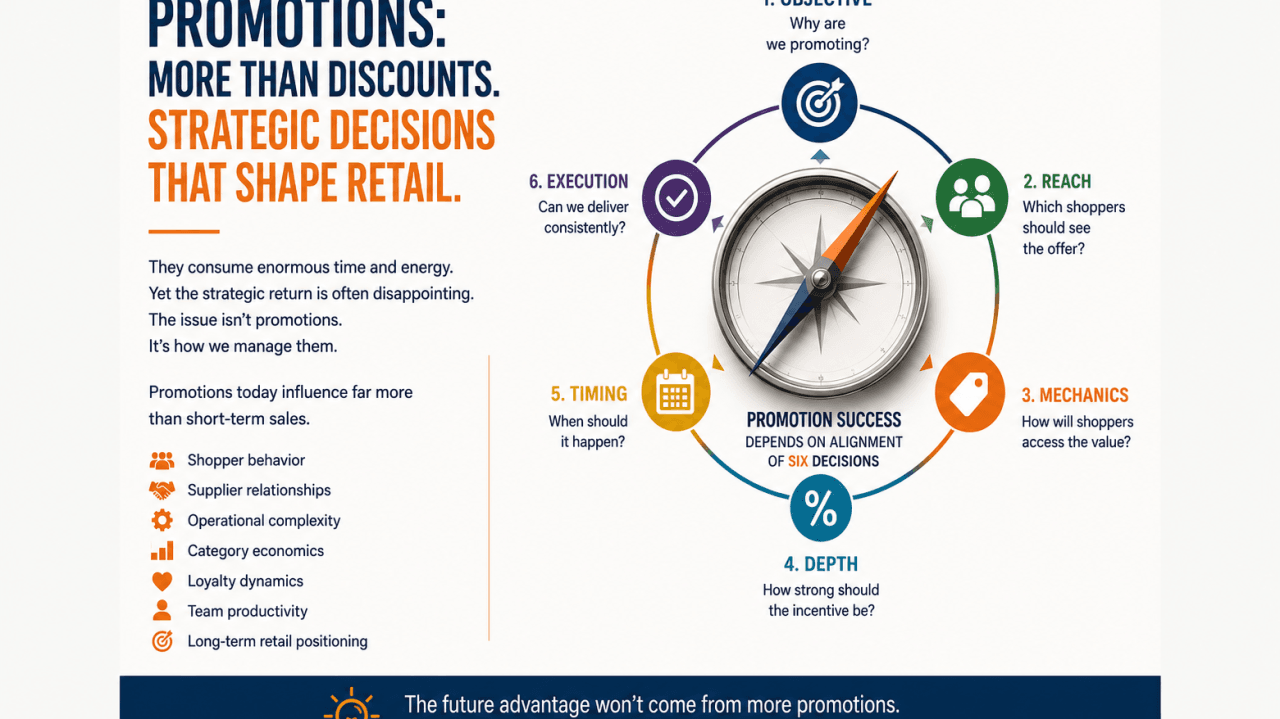
- What it says: Retail organizations are increasingly measuring promotional compliance with high rigor, while inadvertently overlooking the true quality and long-term margin impact of those decisions.
- Why it matters: A packed promotional calendar often masks a deeper deficit in commercial intentionality. When teams optimize isolated KPIs or let the calendar dictate activity rather than shopper need, high-volume promotions can systematically destroy baseline gross margin rather than create long-term value.
- What it reinforces: This strongly validates the necessity of governing promotions with the same strategic rigor as capital allocation. It underscores the value of the Promotion Decision Centre, proving that future competitive advantage will not come from running more promotions, but from executing fewer, better-connected ones built on a unified commercial logic.
Success in the remainder of 2026 will not belong to the retail organizations that accumulate the most data, but to those that can connect their insights to execution at scale. By replacing the isolated reflexes of the past with the coordinated flow of a true Retail Decision System, organizations move past the noise of the dashboard and turn decision alignment into a structural competitive advantage.
Is your commercial team still relying on reflexes, or are they executing a system?